

safety, driven by dedication, and delivering innovation.
💡 Key Summary of This Article
An in-depth technical analysis of leak detectors for industrial safety. This article examines the critical limitations of conventional film, cable, and optical leak sensors, including durability and false alarms, and introduces the innovative technology of Yoohantech electronic point leak sensors, which can clearly distinguish water from hazardous chemicals such as acids, alkalis, and organic solvents.
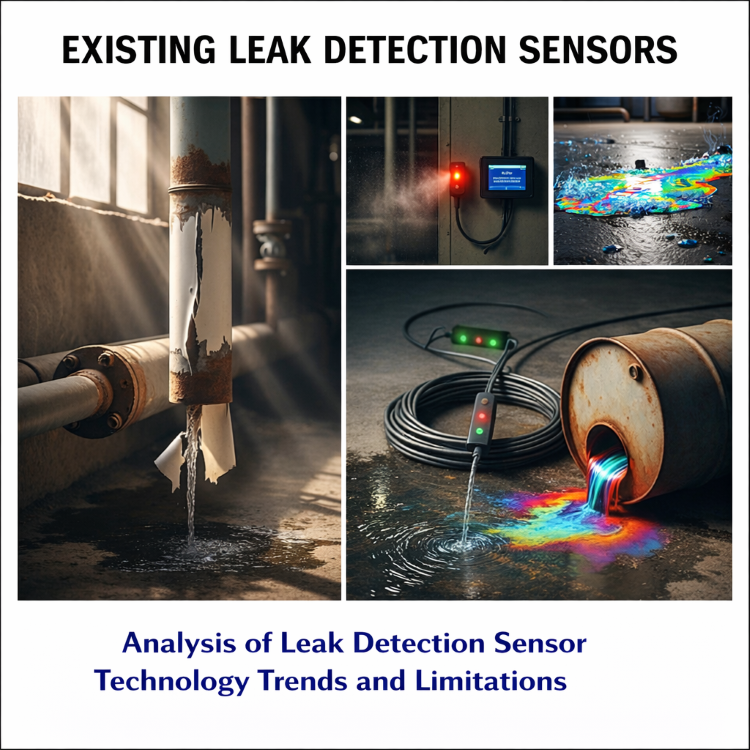
Leaks of various chemicals used in industrial facilities, including acids, alkalis, inorganic solvents, and organic solvents (VOCs), can directly lead to serious industrial accidents. Therefore, technology that detects leaks early and accurately is a core element of safety management for protecting assets, personnel, and the environment.
This document analyzes the operating principles of leak detection sensor technologies commonly used in industry today, including film, cable, and optical types, and explains the clear limitations and issues of each technology to show why a more advanced solution is needed.
Analysis of Major Leak Detection Sensor Technologies
A. Film Type Sensor
1. Operating Principle
- This type has a structure in which a circuit is printed with conductive ink or metal on a thin insulating film made of PET or polyimide (PI).
- When liquid contacts the film surface and electrically shorts the two electrodes, the sensor detects this condition and triggers a leak alarm.
2. Technical Limitations and Issues
- Durability Issues: The printed circuit is highly vulnerable to ultraviolet light and moisture, so it is easily damaged. In outdoor environments, its service life is often less than 6 months, resulting in poor reliability.
- Installation and Maintenance Difficulties: Because it must be fixed directly to the floor, it can interfere with worker movement or equipment traffic and is easily damaged by physical pressure. Partial repair is not possible, so even minor damage requires replacement of the entire film, which increases maintenance cost.
- Cost Efficiency: The price per meter is relatively high, creating a heavy initial investment burden, and frequent replacement increases total cost of ownership (TCO).
B. Cable Type Sensor
1. Operating Principle: Depending on the type of target liquid, cable sensors generally use two different methods.
- Conductive Method: This method uses the principle that conductive liquids, such as water, acids, and alkalis, short the two internal wires of the cable.
- Swelling Method: When non-conductive liquids such as oil come into contact with the cable, a special polymer material inside the cable physically swells, and this change is detected.
2. Technical Limitations and Issues
- Detection Selectivity and Response Speed Problems
-
- The conductive method cannot distinguish between water and hazardous chemicals and reacts to all conductive liquids.
- The swelling method can detect oil only, but its detection time for certain oils such as diesel or kerosene can exceed 40 minutes, which is too slow for early warning. It also cannot distinguish water from organic solvents.
- Poor Economy and Non-Reusability: Most products are single-use and require replacement of the entire cable after one detection event, resulting in very high replacement cost.
- Physical Vulnerability: Like film sensors, they can interfere with work flow when fixed on the floor and are exposed to damage from external pressure.
C. Optical Type Sensor
1. Operating Principle
- This type uses the principle that the refractive index changes depending on whether liquid is present. The sensor detects changes in the emitted light beam and judges whether a leak has occurred. Many products are point sensor types with integrated sensing and alarm functions.
2. Technical Limitations and Issues
- Reduced Reliability and False Alarms: Because it detects subtle changes in light, it is highly sensitive to environmental factors such as dust, humidity, and lighting changes, which often causes false alarms. This significantly reduces trust in the sensor.
- Lack of Detection Selectivity: It reacts to all liquids in the same way, so it cannot distinguish water from other chemicals at all.
- Installation Environment Limitations: Due to its sensitivity to environmental changes, outdoor installation is almost impossible, and it can only be used in limited stable indoor environments.
Existing major leak detection technologies clearly have technical limitations in durability, detection selectivity, reliability, and cost efficiency. In particular, the inability to distinguish water from hazardous chemicals, frequent false alarms caused by environmental factors, and high maintenance costs are major obstacles to securing safety in industrial facilities.
For this reason, there is an urgent need for a next-generation leak detection technology that can operate reliably for long periods even in harsh outdoor environments, clearly distinguish water from organic solvents, and quickly detect only the target material without false alarms.
Yoohantech Leak Detector Product Lines
A. Yoohantech Electronic Inorganic Solvent Leak Detector
Protect your safety and assets with next-generation leak detection technology.
1. Development Background: The Beginning of a New Paradigm
To go beyond the clear limitations of conventional leak detection technologies, Yoohantech started from a fundamental question: “Doesn’t every chemical have its own unique characteristics?”
As the answer to that question, we developed the world’s first innovative leak detection technology that precisely analyzes the unique electrical properties of each chemical and accurately identifies only the target substance.
2. Core Technology: Electronic Detection Principle
Yoohantech’s electronic leak detector was developed based on the fact that inorganic solvents, which are not carbon-based, show different electrical flow characteristics from one another.
- Operating Principle: The sensor precisely measures minute changes in electrical flow generated by liquid between two high-sensitivity electrode rods and analyzes them with a proprietary algorithm to determine whether the pre-set target substance is leaking. This is fundamentally different from conventional methods that rely only on short circuits or refractive index changes.
3. Product Lineup
We provide optimized solutions for a wide range of customer environments and requirements.
| Category | Model | Description |
|---|---|---|
| Detector | YHSP-SAR | Separated Type (Requires external detection module) |
| YHSP-SAR-Ex | Explosion-Proof Separated Type (Requires external detection module) | |
| YHSM-AR01 | Integrated Type (Built-in detection module function) | |
| Detection Module | YHSM-04S-AR | 4-Channel (Connects and controls up to 4 detectors simultaneously) |
| YHSM-01S-AR | 1-Channel (Connects and controls 1 detector) | |
| Setting Module | YHSM-PSTG | Dedicated module for customized settings of integrated detectors |
4. Key Advantages
√ Outstanding Detection Selectivity: Designed to minimize false alarms.
- It clearly distinguishes ordinary water such as tap water, groundwater, and rainwater from hazardous chemicals and detects only the target material. With optimized settings tailored to each substance, it provides detection within 5 seconds for acid and alkali materials and within 10 seconds for other substances.
√ World’s First Precision Detection Technology for UPW/DIW
- It completely solves the chronic false alarm issues of conventional optical sensors caused by dust and environmental changes. With unique technology that can accurately distinguish ultra-pure water (UPW) and deionized water (DIW), which are critical in semiconductor processes, from ordinary water, Yoohantech is raising safety standards in the semiconductor industry.
√ Customized Solution: Accurate Detection for Any Target Chemical.
- It can accurately detect even special inorganic solvents that conventional detectors fail to detect. We directly test every chemical used by the customer in advance and provide optimized custom setting values for that material. To ensure maximum trust, all testing processes are transparently shared through video.
√ Semi-Permanent Durability and Excellent Cost Efficiency
- It offers strong durability and is hardly affected by contamination, humidity, or temperature changes in both indoor and outdoor environments. After detection, it can be reused immediately with simple water cleaning, significantly reducing maintenance costs compared with conventional sensors that require frequent replacement.
B. Yoohantech Electronic Organic Solvent Leak Detector
A unique technology that detects only organic solvents quickly and accurately, raising your safety standard to the next level.
1. Development Background: A New Standard for Organic Solvent Detection
Yoohantech focused on the unique chemical and physical properties of organic solvents. Organic solvents, which are carbon-based, block electrical flow and expand under specific conditions. By precisely controlling this principle, we developed the world’s first electronic leak detector using the chemical resistance method, providing a new safety solution beyond the limits of conventional technologies.
2. Core Technology: Chemical Resistance Method
Yoohantech’s electronic leak detector simultaneously uses two core characteristics of organic solvents.
① Electrical Resistance: When an organic solvent contacts the sensor, it interferes with electrical flow and sharply changes the resistance value.
② Physical Expansion: The sensor material fuses with the organic solvent and undergoes physical expansion.
By analyzing these two combined signals with a proprietary algorithm, the detector accurately identifies leaks of organic solvents only, clearly distinguishing them from other liquids.
3. Product Lineup
We provide optimized solutions for a wide range of customer environments and requirements.
| Category | Model | Description |
|---|---|---|
| Detector | YHSP-SA | Separated Type (Requires external detection module) |
| YHSP-SA-Ex | Explosion-Proof Separated Type (Requires external detection module) | |
| YHSM-A01 | Integrated Type (Built-in detection module function) | |
| Detection Module | YHSM-04S-AR | 4-Channel (Connects and controls up to 4 detectors simultaneously) |
| YHSM-01S-AR | 1-Channel (Connects and controls 1 detector) | |
| Setting Module | YHSM-PSTG | Dedicated module for customized settings of integrated detectors |
4. Key Advantages
√ Perfect Detection Selectivity: Excludes water and detects only organic solvents.
-
It does not react at all to rainwater, groundwater, or industrial water, and selectively detects only the target organic solvent, fundamentally preventing false alarms. With customized settings, it provides detection within 5 seconds for volatile substances and within 30 seconds for most other organic solvents.
√ Outstanding Oil Detection Performance
-
It can detect leaks of diesel, kerosene, and similar oils within 5 minutes, compared with more than 40 minutes required by conventional cable methods. Thanks to this outstanding performance, many oil tanks and related facilities in Korea are increasingly replacing conventional methods with Yoohantech leak detectors.
√ Customized Solution: Compatible with All Organic Solvents.
-
It can accurately detect even special organic solvents that are difficult to identify with conventional technologies. We directly test all chemicals used by the customer in advance and provide optimized custom setting values for each material. Every test process is transparently shared through video to ensure maximum trust.
√ Innovative Durability and Cost Efficiency
-
It offers strong durability and is hardly affected by contamination, humidity, or temperature changes in both indoor and outdoor environments. After chemical detection, the sensor can be reused immediately by simply replacing the floor sensor only. Unlike conventional tape or cable methods, if only part of the sensor is damaged, only the floor sensor needs to be replaced, which provides excellent maintenance efficiency and low operating cost.
Benefits of Choosing Yoohantech Leak Detectors
1. Complete Solution for Outdoor Installation
- Conventional products in Korea and overseas have long faced major challenges in outdoor installations, including false alarms caused by rainwater and durability problems in harsh environments. Yoohantech leak detectors do not react to rainwater and detect only the target chemical accurately, while also offering strong durability that can withstand demanding environments. Combined with low maintenance cost, they provide a complete solution for outdoor leak detection.
2. Unique Accuracy in Organic Solvent Detection
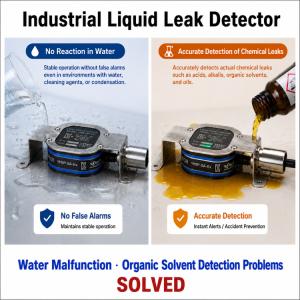
- In facilities using a wide variety of organic solvents, it is critical to detect only the target material without false alarms caused by cleaning water or similar factors. Yoohantech leak detectors provide outstanding stability by never malfunctioning in water and accurately detecting all types of organic solvents. In addition, unlike competitor products, only the sensor part needs to be replaced in case of leak detection or sensor damage, enabling semi-permanent use and very low maintenance cost.
3. Detection of All Inorganic Solvents and Strong Competitiveness in the Semiconductor Market
- As the semiconductor market continues to grow rapidly with the expansion of AI and advanced electronics, the importance of technology that can precisely distinguish ultra-pure water (UPW) and deionized water (DIW) from ordinary water is increasing. Yoohantech has the only technology in Korea that fully delivers this capability. By also detecting special inorganic solvents that competitors cannot detect, Yoohantech helps increase customer trust and strengthen market competitiveness.
4. Database-Ready Technology Supporting the Future of AI Leak Detection
- Yoohantech leak detectors support database building by accumulating detection data through custom settings for each chemical. This database will become a key foundation for the future development of AI-based leak detectors. As the data grows, it is expected to enable automatic detection settings by material type and many other advanced applications.
Industry-Specific Leak Detection Proposals
Semiconductors · Petrochemicals · Oil Refining · Batteries · Power Generation · Steel · Warehousing · Wastewater Treatment · Defense
Liquid Leak Detector: Technical Inquiry
We confirm applicability and recommend solutions based on your target liquid and site conditions.
Setting the trusted standard for liquid leak detection in industrial facilities.
I want to









Defining the Trusted Standard in Liquid Leak Detection for Industrial Safety.