

safety, driven by dedication, and delivering innovation.
In facilities handling organic solvents, relying on gas detectors alone is not enough. This article explains why liquid leaks, which often occur before volatile gas buildup, must be detected immediately, compares the technical roles of leak detectors and gas detectors, and presents an optimized safety solution for stronger chemical safety management and regulatory compliance.


If you are responsible for industrial site safety, you may think that installing a gas detector is enough because organic solvents are highly volatile.
However, that is only half of the safety picture. Organic solvent leak accidents often begin in unexpected ways and involve serious liquid-phase hazards that gas detectors cannot capture.
For complete chemical safety, it is essential to focus on the role of the leak detector.

Organic Solvent Risks: The Limits of Gas Detectors and the Need for Leak Detectors
Organic solvents have low boiling points and evaporate easily, generating flammable vapor. However, most accidents begin with liquid leakage. Gas sensors alone cannot prevent the following risks:
-
Small crack, critical leak: Damaged valve packing or fine piping cracks may not immediately generate enough vapor for a gas detector to respond. Instead, a small amount of organic solvent can spread in liquid form and contaminate the floor. In this stage, only a liquid leak detection sensor can detect it.
-
Faster spread than vapor: Leaked liquid organic solvent can rapidly spread across the floor, creating a wider secondary explosion risk and environmental contamination. Without fast liquid leak detection, the scale of damage can grow quickly.
-
Confusion about the leak source: Gas detectors measure vapor concentration in the air, making it difficult to identify the exact origin of the leak. In contrast, a leak detector can pinpoint the leak location.
For this reason, preventing organic solvent accidents requires more than gas monitoring. Installing leak detectors that fundamentally detect liquid leaks at the source is essential.

✅ Chemical Leak Detectors: Pinpointing the Exact Start of an Accident
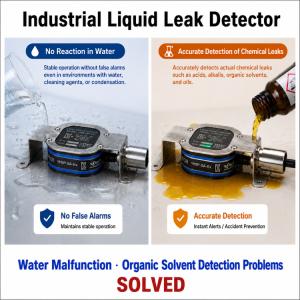
To provide complete protection against organic solvent leaks, the most important step is to detect liquid leakage as early as possible. YOOHANTECH’s leak detection solution complements the blind spots of conventional gas detectors.
-
First line of defense: Leak detectors are installed at high-risk leak points such as pump bases, pipe flanges, and tank containment areas. Before vapor spreads, they trigger an alarm as soon as liquid reaches the sensor, enabling immediate initial response.
-
Pinpoint location tracking: Point sensors or sensing cables provide the exact leak location to site managers. This plays a critical role in helping emergency teams identify the source immediately and isolate the leak by shutting off the valve.
-
Prevention of contamination spread: By detecting leaks before they spread across the entire floor area and triggering an alarm, the system helps minimize workplace contamination and prevent fire escalation.


Conclusion: Installing Leak Detectors for Organic Solvents Is the Key to Safety
Safety in facilities handling organic solvents is achieved through the combined synergy of gas detectors and leak detectors.
However, the first and most critical role belongs to the leak detector, which detects liquid leakage, the root cause of many accidents, first and most accurately.
While gas detectors help protect workers from explosion and toxic exposure, leak detectors act as the true front-line safety system, managing risk from the very beginning of an incident.
Build the right leak detection system for your facility today and create a safer environment protected from organic solvent leaks.
Leak detector test videos are available
on our website.
Industry-Specific Leak Detection Proposals
Semiconductors · Petrochemicals · Oil Refining · Batteries · Power Generation · Steel · Warehousing · Wastewater Treatment · Defense
Liquid Leak Detector: Technical Inquiry
We confirm applicability and recommend solutions based on your target liquid and site conditions.
Setting the trusted standard for liquid leak detection in industrial facilities.
I want to











Defining the Trusted Standard in Liquid Leak Detection for Industrial Safety.