💡 Key Guide to Hazardous Chemical Leak Detectors
Leak detectors are essential safety devices for hazardous chemical handling facilities. Discover YOOHANTECH’s electronic point sensors, developed to solve the frequent false alarms and high maintenance costs of conventional film-type and cable-type sensors. Check how they meet Korean installation standards under the Chemicals Control Act, with installation intervals of 10 m indoors and 20 m outdoors, while accurately detecting acids, alkalis, organic solvents, and oils.

Leak detectors are now mandatory, not optional, because hazardous chemicals handled in facilities or equipment can leak and cause serious injury, accidents, and property damage to equipment and plants.
According to the technical standards for "Detection and Alarm Equipment Standards for Hazardous Chemical Handling Facilities [Manufacturing and Use Facilities]",
detection and alarm systems must be installed in order to detect leakage, fire, or explosion of hazardous chemicals in advance.

Let’s take a closer look at leak detectors.
Current Leak Detection Sensor Technology Trends
Leak detectors are widely used across many industries. They are available in various types to detect leaks of acids, alkalis, oils, organic solvents (VOCs), and more, helping prevent industrial accidents before they happen.
Currently, the main types of leak detection sensors in use are cable type, film type, and point type.
◎ Film-Type Sensor
This type detects leaks based on a printed circuit design with electrical resistance values on the sensor film. When liquid leakage occurs, the sensor receives the electrical current value of the liquid and detects the presence of the liquid. These thin-film sensors are typically made of materials such as PET film or PI.
• Advantages: 1. Because it is manufactured by unit length, it can cover a wide detection area.
• Disadvantages: 1. Since it is made by a printed process using PET or PI materials, the printed surface can easily peel off or be damaged by sunlight or rain, resulting in a very short service life.
2. The cost is very high because pricing is based on length per meter.
3. Since it must be fixed separately to the floor, it can interfere with worker movement and is easily damaged under pressure.
4. If only one part of the film is damaged, the entire product must be replaced, making maintenance difficult and uneconomical.
◎ Cable Sensor
A cable sensor is made by twisting two conductors with a constant resistance value in a screw-type structure. When a leak occurs at a given point, it receives the resistance value of the liquid and can detect the leak location and the presence of liquid. However, only limited types of liquids can be detected.
• Advantages: 1. Because it is manufactured by unit length, it can cover a wide detection area.
• Disadvantages: 1. Imported products are expensive, and some can detect only limited liquids such as oils.
2. Locally produced cable sensors can detect only acids, alkalis, and water.
3. Organic solvents cannot be detected at all.
4. Since it must be fixed separately to the floor, it can interfere with worker movement and is easily damaged under pressure.
5. If one section of the cable is damaged, the entire product must be replaced, making maintenance difficult and uneconomical.
◎ Optical Sensor
Optical sensors detect the presence of liquid by using the difference in refractive index between the photoelectric beam and the liquid. Leak sensing and alarm functions are integrated into one unit.
• Advantages: 1. Low cost.
• Disadvantages: 1. Easily reacts even to water.
2. Since it detects liquid based on light refraction, it is highly prone to false alarms due to environmental changes, even indoors.
3. It cannot be installed outdoors.

Because legal installation practices for leak detectors were not clearly established in the past, film sensors were often installed by surrounding tanks or equipment completely around the perimeter. Oh my god!!!
Sensor costs are high, and installation costs are also significant.
With frequent breakdowns that do not even last 3 months, maintenance costs become excessive.
As a result, in many real-world sites, even after the initial installation, the system is often left powered off when failures occur.
Leak detector calibration and inspection are meant to verify whether the detector is functioning properly by testing its operation. However, in Korea, proper verification of leak detectors was often not carried out due to product limitations.
<Reference>
| Detailed Standards of "Detection and Alarm Equipment Standards for Hazardous Chemical Handling Facilities [Manufacturing and Use Facilities]" |
| 1) The installation location and number of detector units for detection and alarm equipment shall comply with the following standards. (1) Around manufacturing and use facilities, detectors shall be installed in places where leaked chemicals are likely to remain, at a ratio calculated as at least 1 unit for every 10 m of floor perimeter indoors, and at least 1 unit for every 20 m of floor perimeter outdoors. (2) The installation height of the detector units shall be appropriately determined according to surrounding conditions, equipment height, and the characteristics of the chemical facilities. |
Now, installation can be calculated simply by using at least 1 detector for every 10 m of floor perimeter indoors, and at least 1 detector for every 20 m of floor perimeter outdoors.
As a result, optical point sensors were also widely installed, but in many cases these too were left turned off because of frequent false alarms and product failures. Oh my god!!!

This is a serious problem.

To solve all of these issues, YOOHANTECH developed the Electronic Leak Point Sensor.
Electronic Leak Point Sensor
◎ [Acids, Alkalis, and Inorganic Solutions]
Based on electrochemical principles, this sensor detects leaks quickly and accurately. When liquid enters the conductive part, an electrical reaction occurs, causing the resistance value in the circuit to change and allowing current to flow. This current change plays a key role in detecting the presence of liquid.
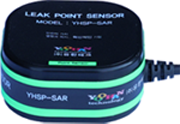
YHSP-SAR (Separated Type)
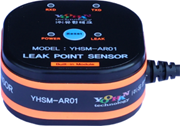
YHSM-AR01 (Integrated Type)
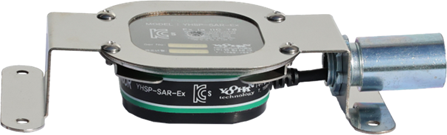
YHSP-SAR-Ex (Explosion-Proof Type)
• Reusable after simple water cleaning.
• Dedicated to acids, alkalis, and inorganic chemical solutions.
• Does not react to water.
• Strong resistance to external impact and noise, suitable for both indoor and outdoor installation.
◎ [Organic Solvents and Oils]
Based on electrochemical principles, this sensor detects leaks quickly and accurately. When liquid enters the bottom of the sensor, the surface tension on the sensor is broken, causing the resistance value in the circuit to change and allowing current to flow. This current change plays a key role in detecting the presence of liquid.
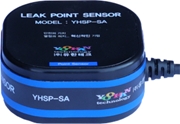
YHSP-SA (Separated Type)
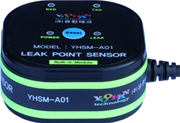
YHSM-A01 (Integrated Type)
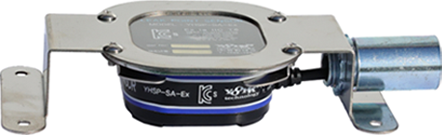
YHSP-SA-Ex (Explosion-Proof Type)
• Distinguishes between water and organic solvents or oils, detecting only target chemicals
• If the floor sensor is damaged by leakage of organic chemicals or oil-based substances, only the floor sensor can be detached and replaced, allowing the main product to be reused at any time. (Floor sensor sold separately)
• Does not react to water.
• Strong resistance to external impact and noise, suitable for both indoor and outdoor installation.

Now, stop worrying about leak detectors...!!!
YOOHANTECH Co., Ltd. is committed to helping prevent personal injury, accidents, and property damage caused by chemical leaks at customer sites.
If you have any questions or need technical support, please feel free to contact us at any time.
We are here to provide clear answers to your application needs.
Liquid Leak Detector: Technical Inquiry
We confirm applicability and recommend solutions based on your target liquid and site conditions.
Setting the trusted standard for liquid leak detection in industrial facilities.